
This case study is part of my Interaction Designer application at Google London.
I had one week to come up with a concept for a 'waiting staff review' experience, design a high-level flow and supporting wireframes.
Date: 2018 | Client: Google | Employer: Self Employed | Role: Interaction Designer

THE DESIGN BRIEF
While there are many ways to rate and review restaurants, these are not focused on evaluating individuals servers. Design an experience where diners can submit positive comments and constructive suggestions for the wait staff, and servers can use this feedback to both improve and help to secure new employment.
WHY ITS IMPORTANT
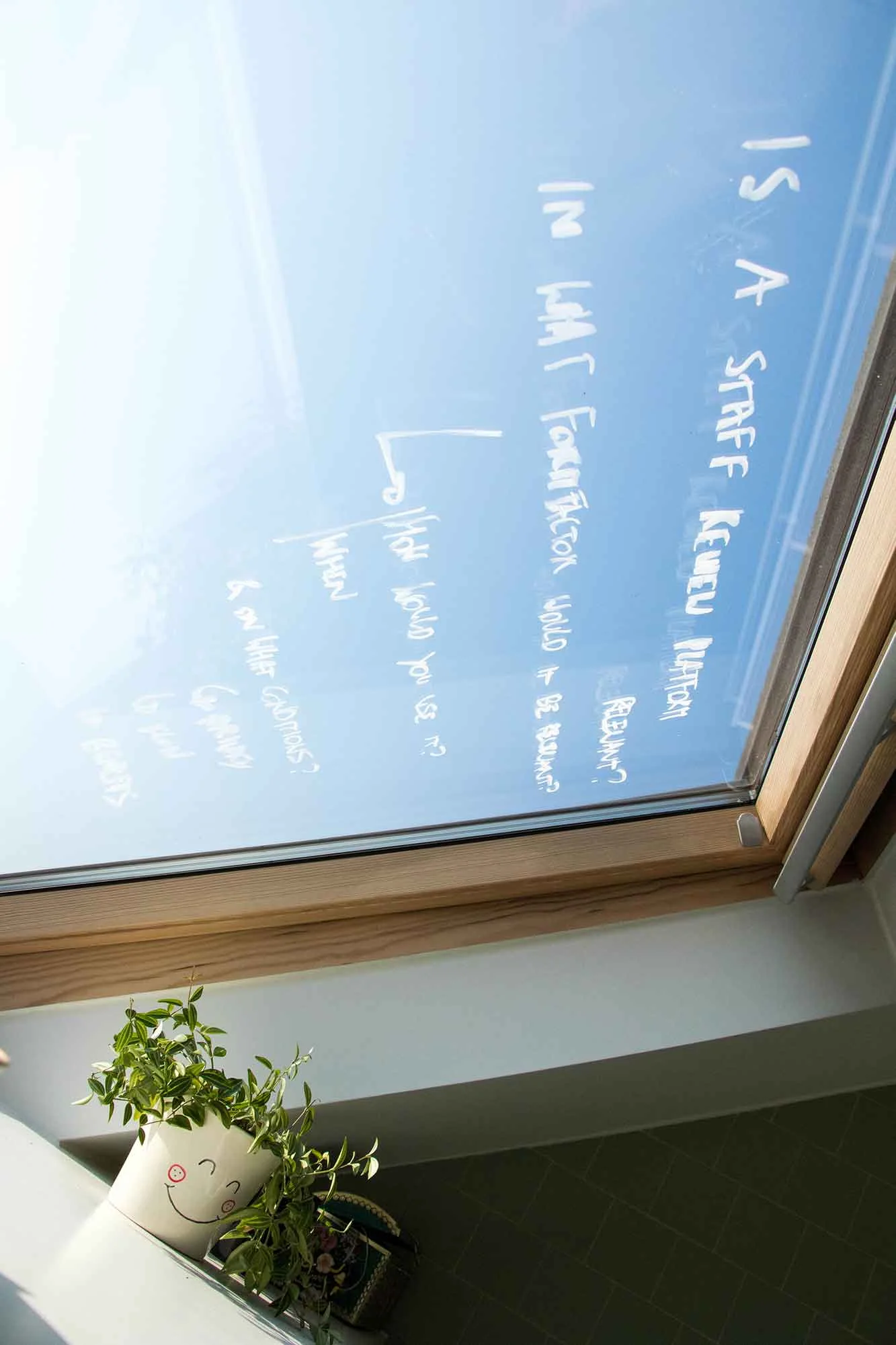
I had my own opinion of course, but I reached out to friends, family and local restaurants/bars to set up in-depth interviews in order to get an outside-in perspective that would help me navigate my own bias. So I set out to find an answer to the questions: "Is a waiting staff review platform relevant?" and "In what format would it be relevant?" In 13 separate interviews, they told me this as to why they believe more feedback is important:
6 CUSTOMERS
"We always choose a venue that fits the moment and amplifies the mood, so if we could get some more information about a certain waiting style, that would be incredibly helpful!"
8 WAITING PROFESSIONALS
"Belgians are notorious when it comes to feedback: they won't easily tell you what they think straight to your face... as a waiter this is frustrating, because you might not know you're doing something wrong."
3 VENUE OWNERS
"We already invite applicants to come in for a try-run, but this isn't conclusive... a lot of people just fake it for a couple of days. A structured feedback process might help us to find more qualified, passionate employees."
And this is what they told me about why it's also a reason for concern:
"If we start doing this for waiting staff... what's next? This just reminds me of that one episode in Black Mirror!"
"If there was a public platform that would allow people to rate and review me personally, I would leave the food service industry immediately! I'd become incredibly insecure with people judging my every move at work."
"As a starting business feedback would be incredibly helpful, but if it would be available for anyone to see this might hurt our business before we're even properly started!"
6 BUILDING BLOCKS
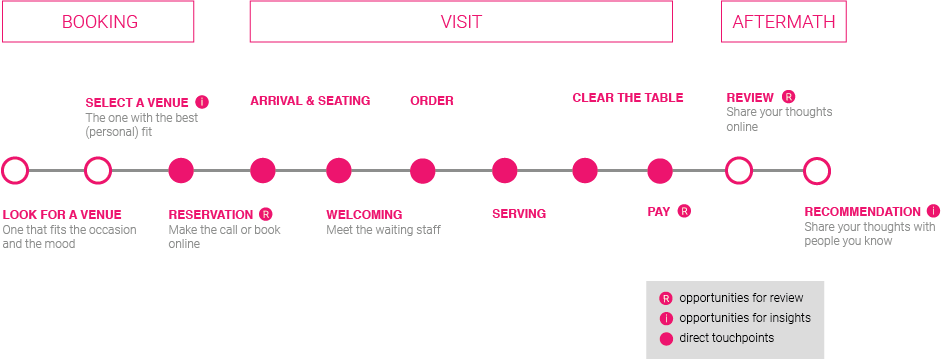
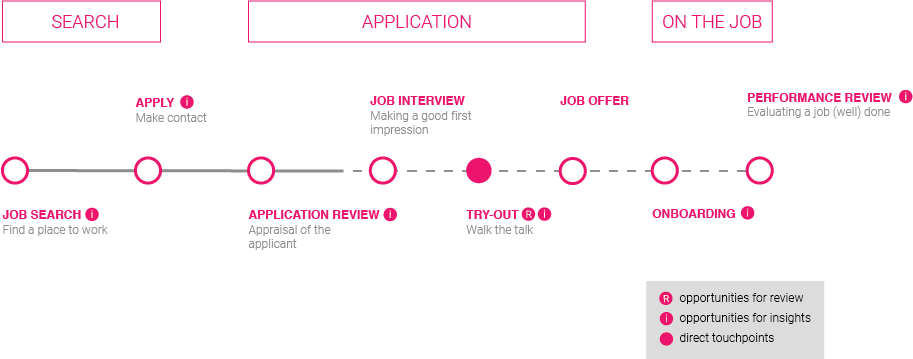
Looking at the journey of both the customer when they visit a restaurant and the employees when they're jobhunting in the hospitality industry, combined with the insights I gained from talking to the different stakeholders, I came up with these 6 themes that would have to serve as pillars for my 'Wait Staff Review' concept:
EASE OF USE
The feedback flow should be easy to understand and unintrusive. Giving feedback shouldn't disrupt the dining experience.POSITIVITY
Giving feedback shouldn't result in personal vendetta's. Positivity is key! The goal is always to help people grow through constructive criticism and positive feedback, but this is a sensitive matter.COMMUNITY
The hospitality industry already thrives on personal networks and we could grow this even further by digitally augmenting it and highlighting connections that might have otherwise been difficult to spot. Because of the sensitive nature of personal/individual feedback a closed platform is the way to go, this is the best way to guarantee someone's privacy.STYLE
By focussing on style instead of ratings I hope we might spark internal reflection rather than imposing the feeling of constantly being judged. Waiting staff get confirmation on whether they come across as they themselves believe they do. There is also value in matching waiting staff with venues that have the same priorities and values.INSIGHTS
Both employees and employers want to know what works and what doesn't. A structured approach to feedback should prove more nuanced and objective than the occasional comment from a customer or online reviews.INCENTIVE
In order to make this work, it needs to be a win for everyone involved: patrons should be inclined to give feedback, waiting staff should want to get the feedback and management should see the implementation of such a process as an added value.
Meet FeatBACK.

FeatBACK EH?
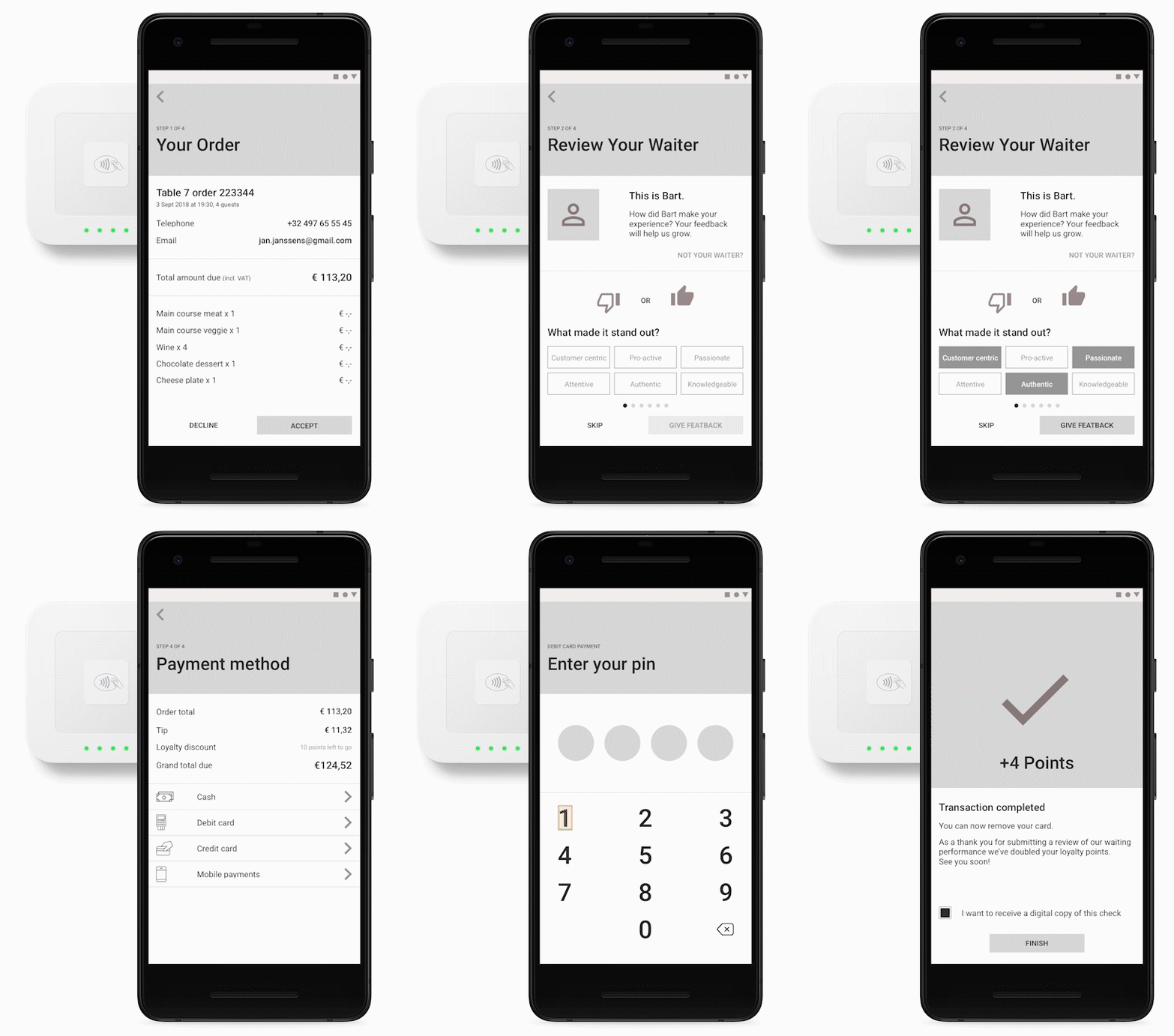
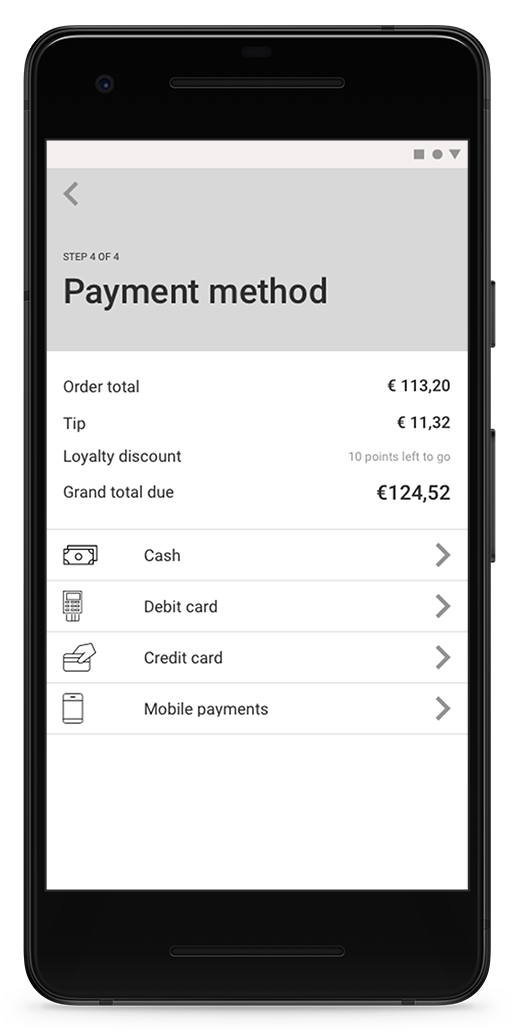
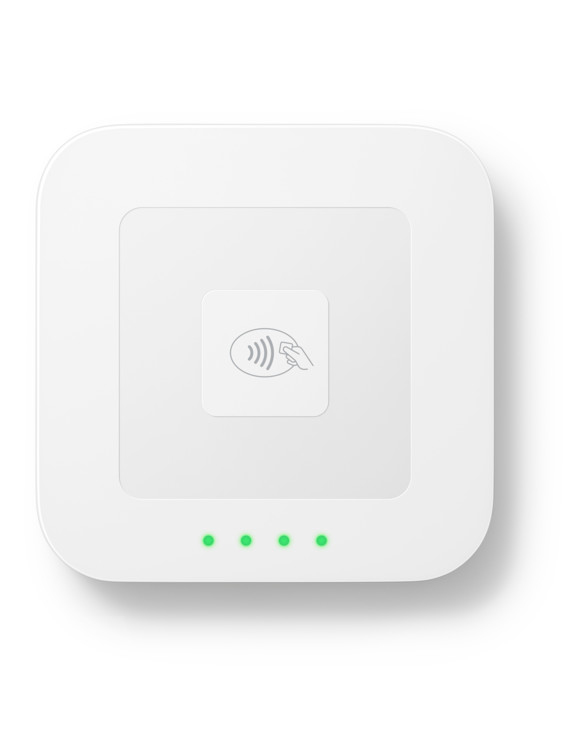
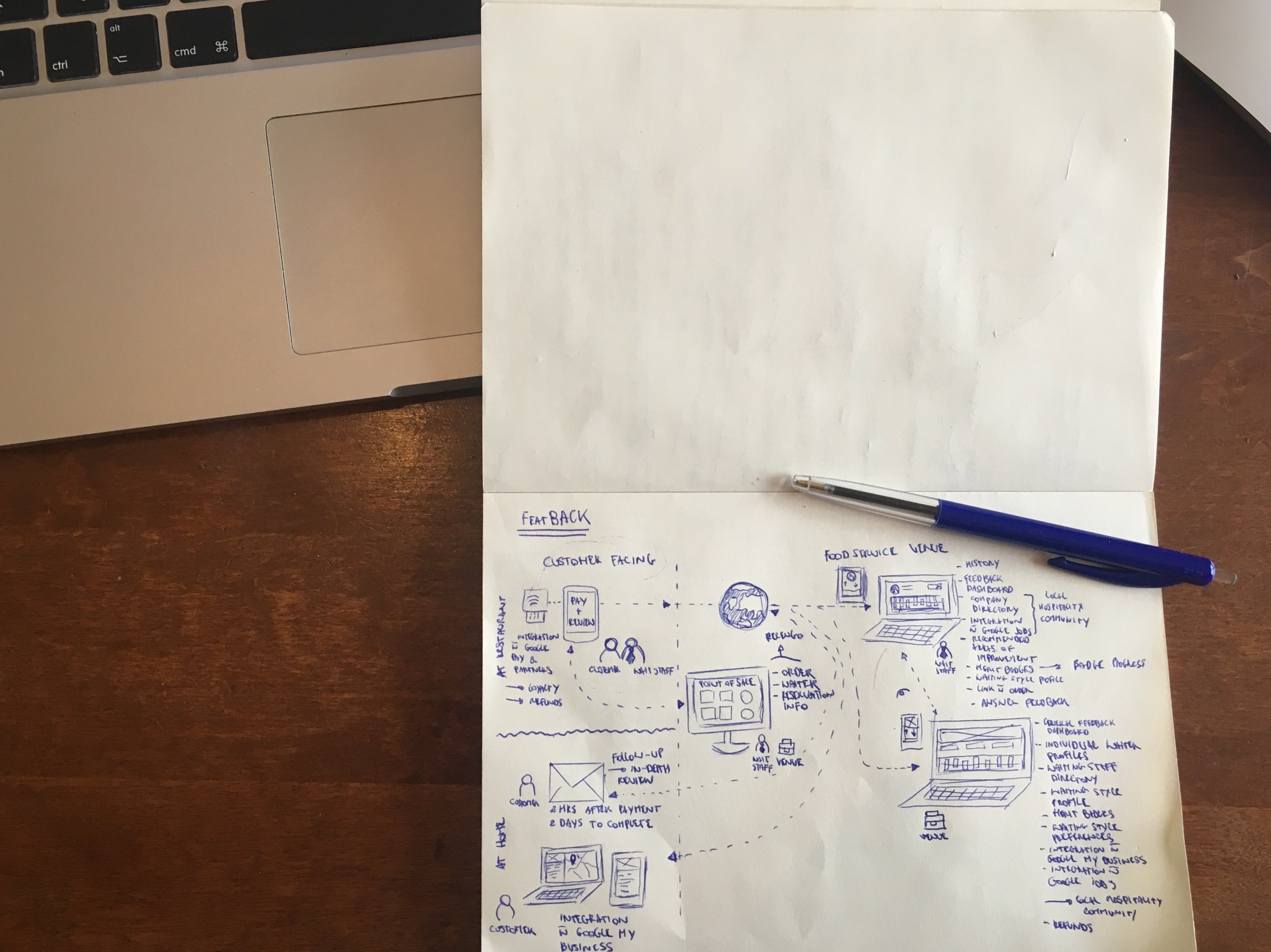
Yes, FeatBACK. It's a mobile solution that seamlessly integrates into any payment flow thanks to Google Pay's pre-existing partnerships with mobile Point Of Sale systems such as Square. By doing so we can offer a digital feedback process to any customer whether they wish to pay cash, by card or mobile.
Integrating into the payment flow has two main advantages: you reach all your customers (although they might not want to leave a review) and all reviews are immediately validated as being from actual clients.
P.O.S. systems also bring with them access to a large amount of data: reservations, customer contact details, order details and the name of the waiter that initiated the order. This allows us to pre-fill the app an thus minimise user input, but most importantly: we can follow-up with customers afterwards and send them their feedback for review. This gives customers the chance to revise their original feedback or provide it with some more context. This will result in an ultimately more nuanced review.
THE POWER OF POSITIVITY
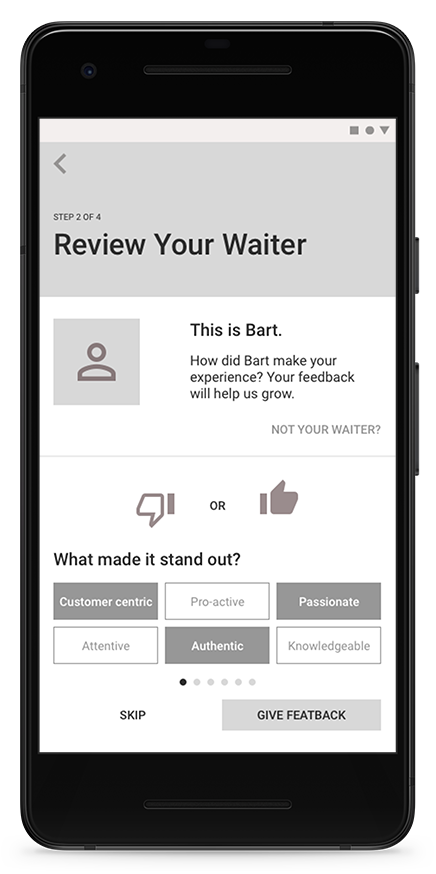
I spent a lot of of time thinking about, and discussing with the stakeholders, a way to handle feedback and constructive criticism in a positive way. On the one hand there's the fear for a lack of restraint in online communication, on the other hand there's the reputation inflation phenomenon. So I opted for a keyword-based appraisal instead of ratings. I even considered forgoing negative feedback entirely, instead using comparisons to colleagues and other local professionals to recommend areas of improvement. But people from all stakeholder groups stressed the importance of constructive criticism to balance out compliments and help people face mistakes and correct their wrongs.
INVOLVEMENT
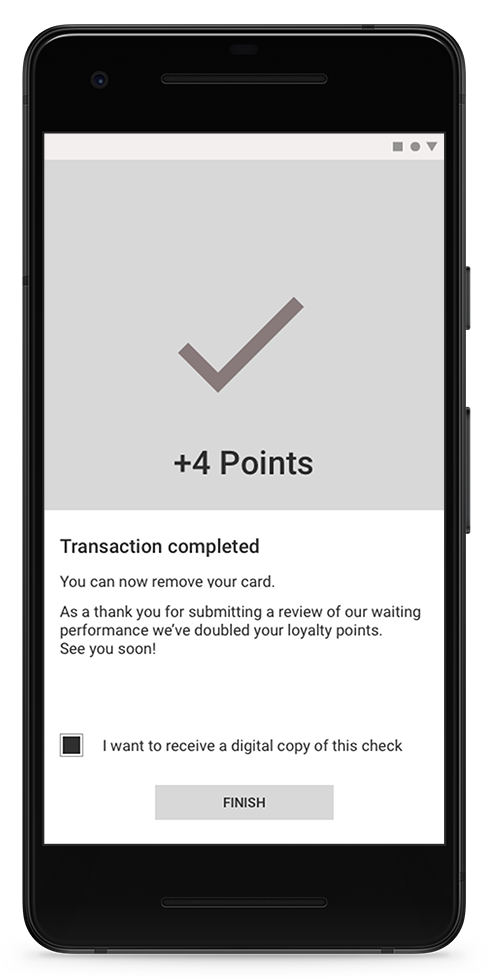
Google Pay has another advantage as it already has built-in loyalty programs. We can tap into that technology to provide customers with an incentive to write a review: extra loyalty rewards.
Giving customers the chance to opt in to a digital receipt offers a prime opportunity to send along their feedback. No need for unsolicited follow-up emails.
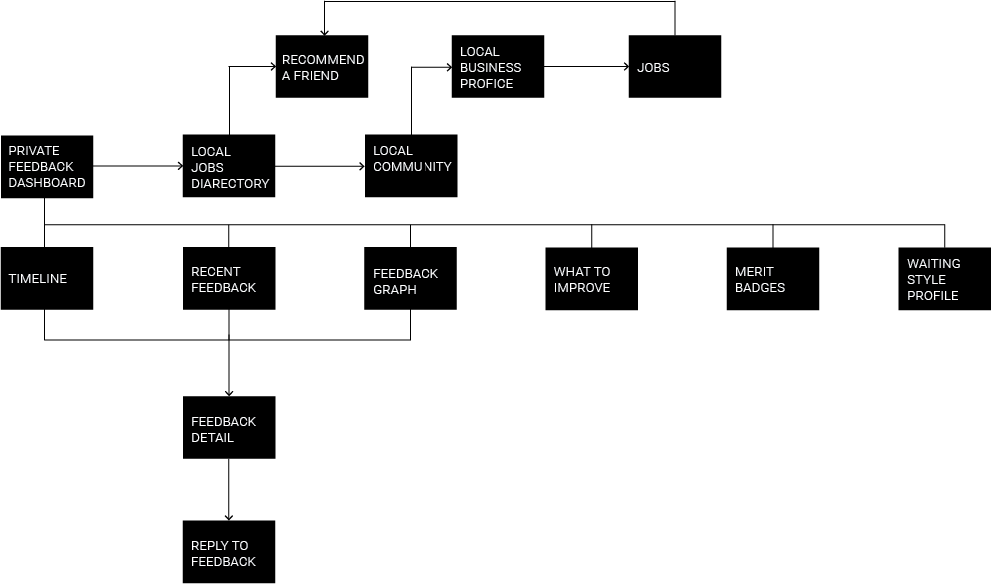
Waiting style & merit badges
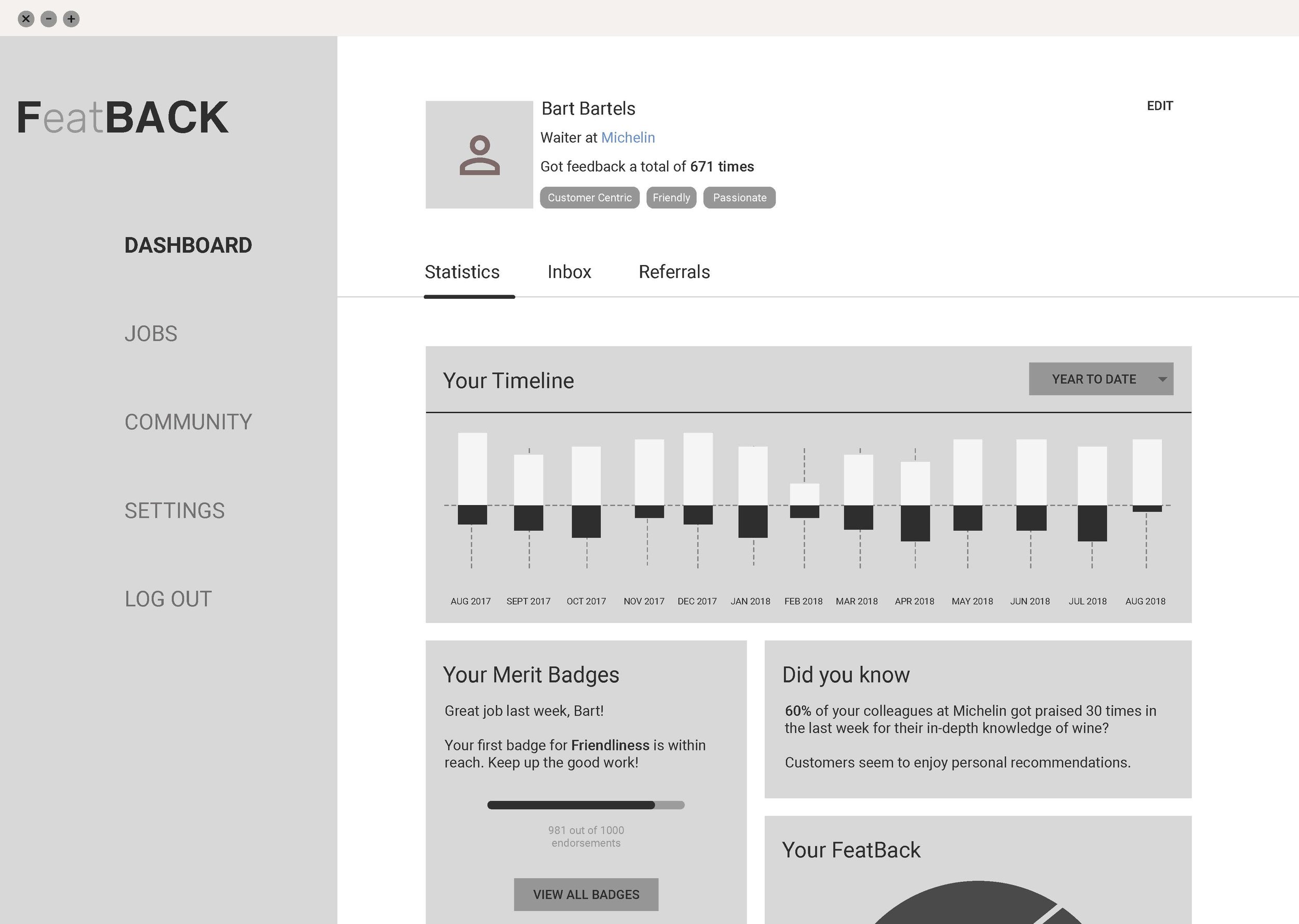
The keywords attributed to a waiting professional will be shown in two different ways to paint both a short-term and a long-term picture of his or her performance for a nuanced overall profile.
On the one hand there is 'waiting style': these are the 3 most received keywords of the past 3 months (both positive and negative). Waiting style gives an idea of the waiter's current performance.
On the other hand you have 'merit badges': all positive feedback ever received contributes to badge progress. These badges will serve to balance out any short-term (potentially negative) feedback.
PRIVATE iNSIGHTS IN A CLOSED COMMUNITY
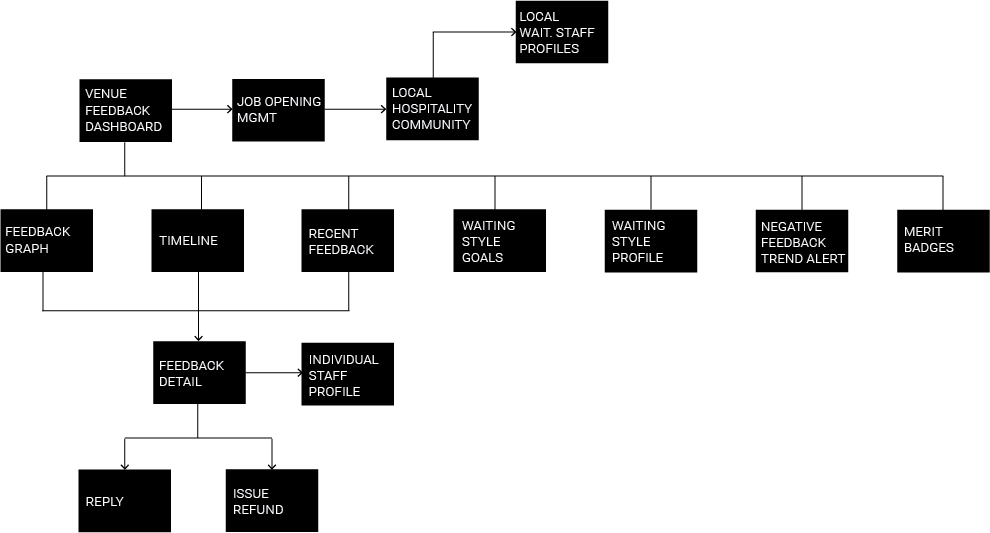
Once you've gathered feedback, you have to start using it. And this is were Google my Business and Google Jobs come into play. Building on these already existing systems, the feedback data can be used in a myriad of ways that bring value to both employers and employees in the hospitality industry.
Individual feedback won't be publicly available (but the feedback average of a business will be visible in Google Maps), but instead be collected in a closed platform: a hospitality industry community.
This community and the data gained from customer feedback will help businesses to match with likeminded employees.
MY DESIGN PROCESS
I chose the 'Wait Staff Review' design challenge because it offered me an interesting, multi-layered process to dive into: there were multiple stakeholders to take into account and the topic of facilitating individual feedback from the general public (in the light of the ever present privacy debate) was bound to stir up some interesting conversations.
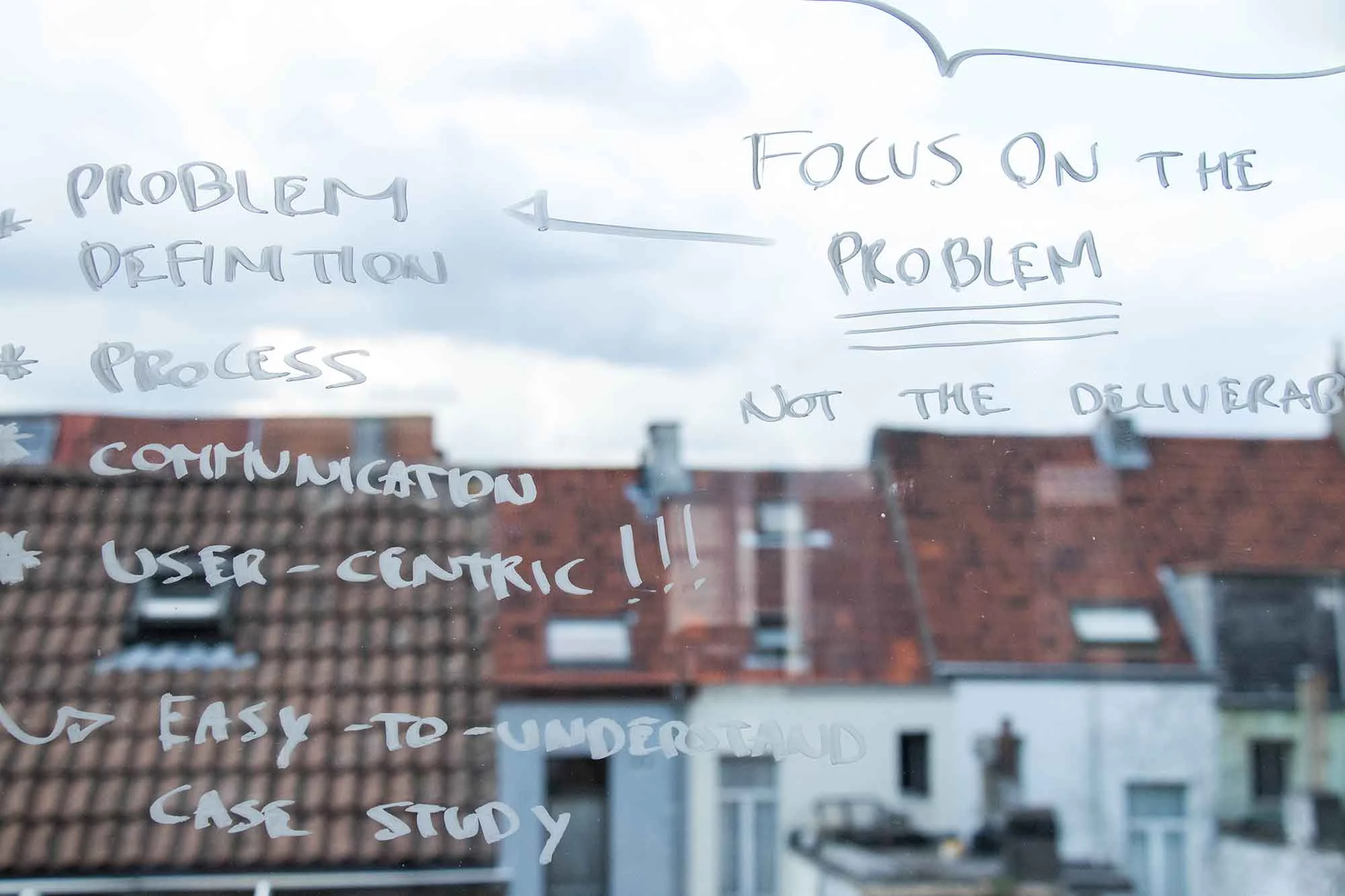
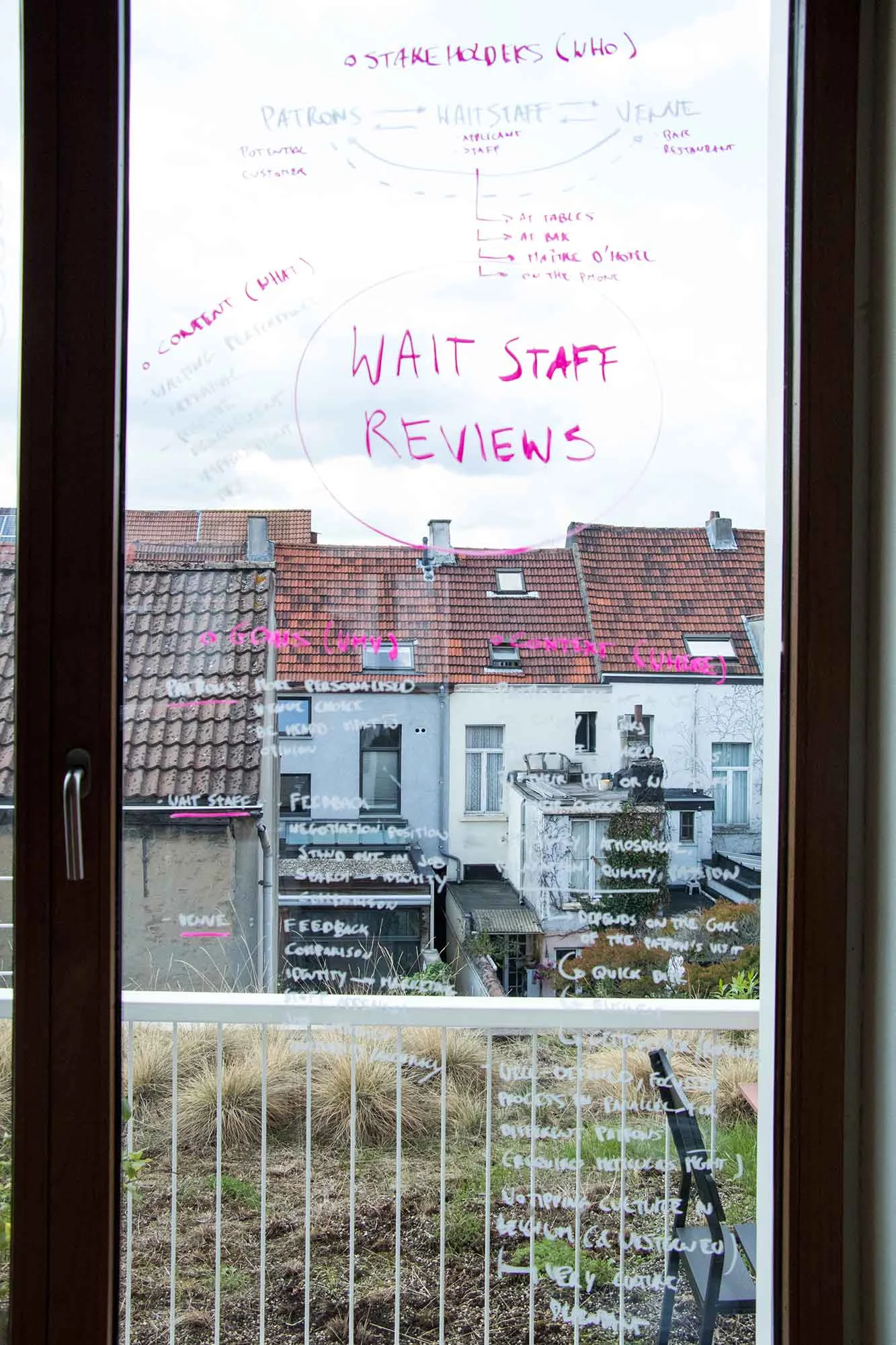
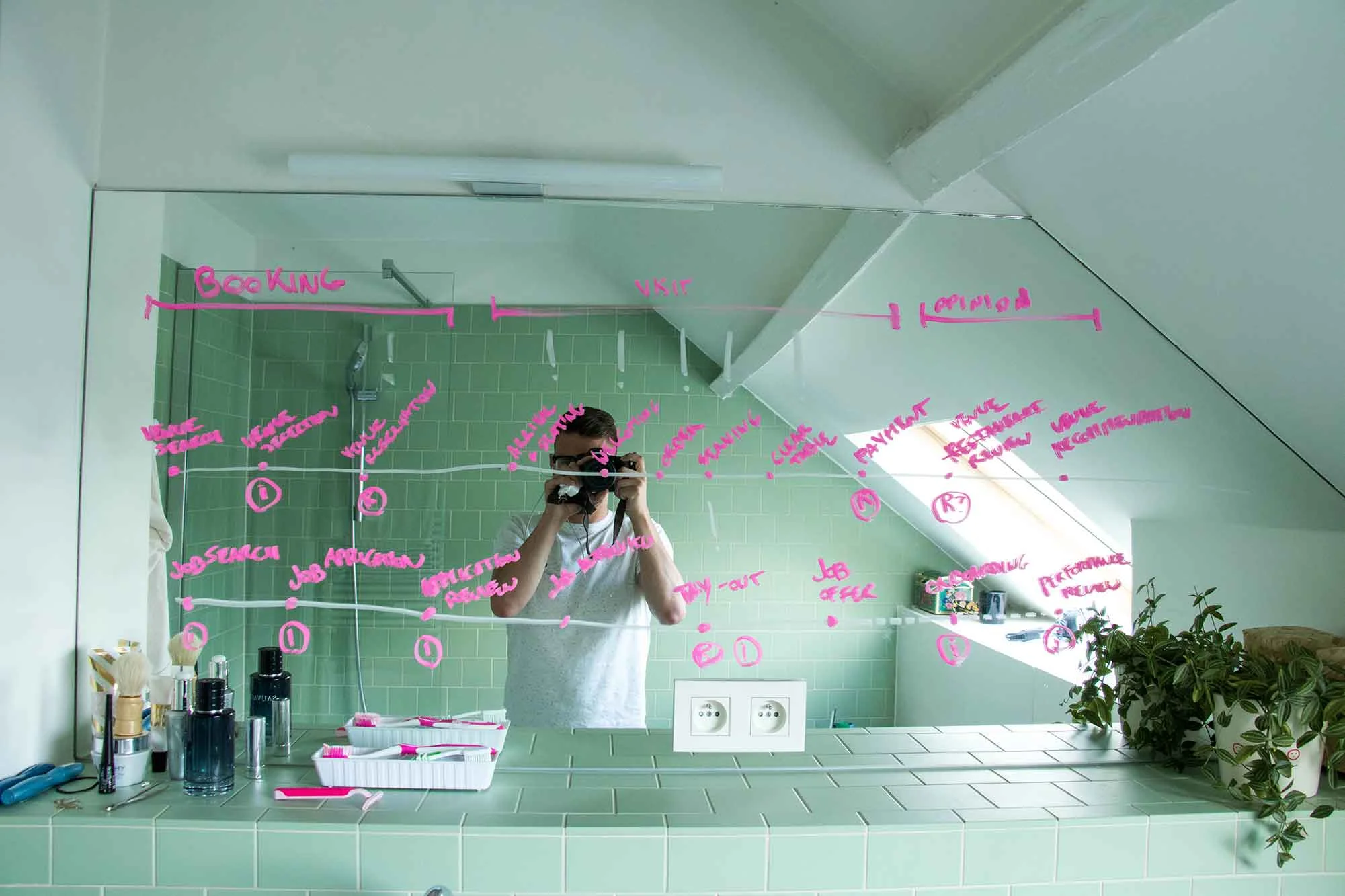
But before I would go talk to those stakeholders I would first break down the assignment into 'Who?', 'What?', 'Where?', 'When?' and 'Why?' to get a feel for the project's scope.
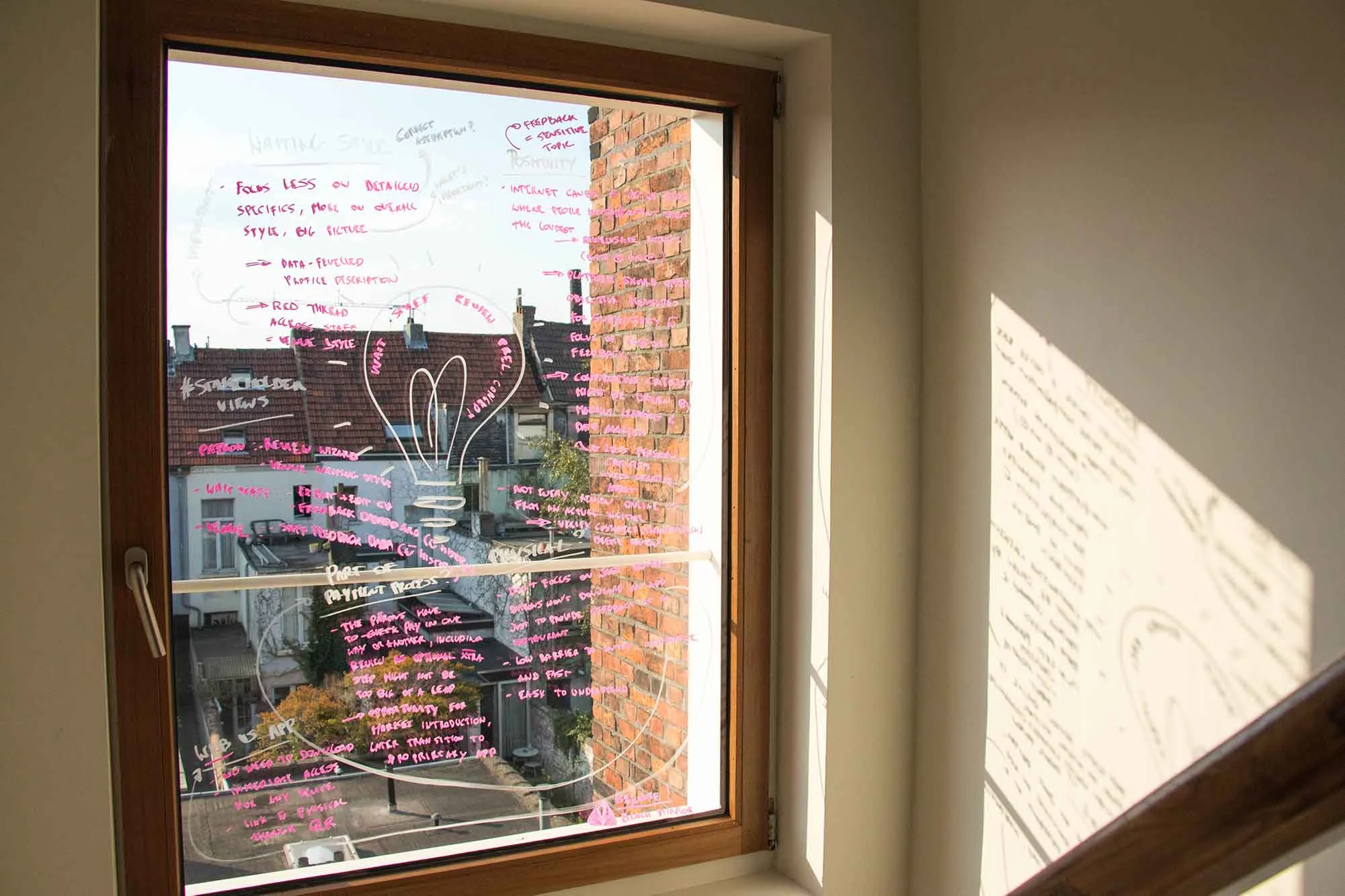
Next up was 'How?' as I ideated about possible solutions based on my inside-out knowledge of the hospitality industry. This helped raise some interesting dilemma's that helped me to come up with questions for the user interviews.
Meeting new PEOPLE
I conducted 13 semi-structured interviews of about an hour each using these questions as a guideline for the conversation. I chose interviews over a survey because of the time-limitation of one week and because the emotional subject matter I estimated I would get more valuable insights out of this face-to-face approach.
Although I was quite familiar with the hospitality industry from the perspective of a patron, I was still occasionally surprised by the answers of both waiting staff, venue owners ànd other customers.
The user interviews not only helped me to gain more insights in te feedback habits of the restaurant-goers in Belgium, but also to highlight my own prejudices about age and openness towards digital platforms.
CONNECTING THE DOTS...
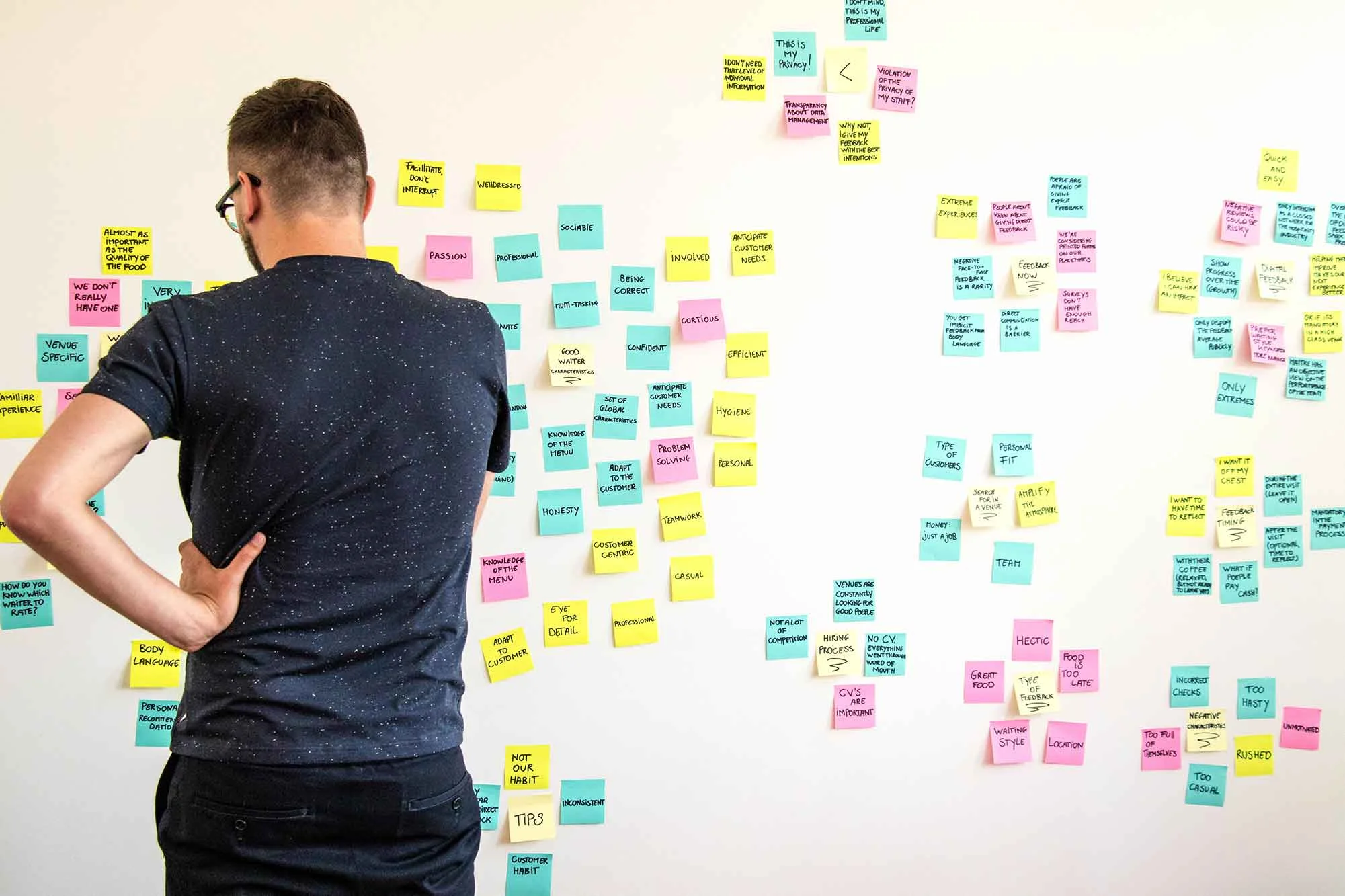
I gathered all the interview insights in a good old-fashioned Excel (you can view the anonymous version here), grouped them and switched to the UX-er's favourite weapon (Post-It's) which helped me to easily cluster insights and kickstart my next brainstorming session.

...AND FINDING SOLUTIONS
Once again I took to the window to sketch out ideas and I booted up the internet to look for payment technology and research about the impact of (negative) (digital) feedback. Steadily inching towards my final proposal.

the waiting staff joined in
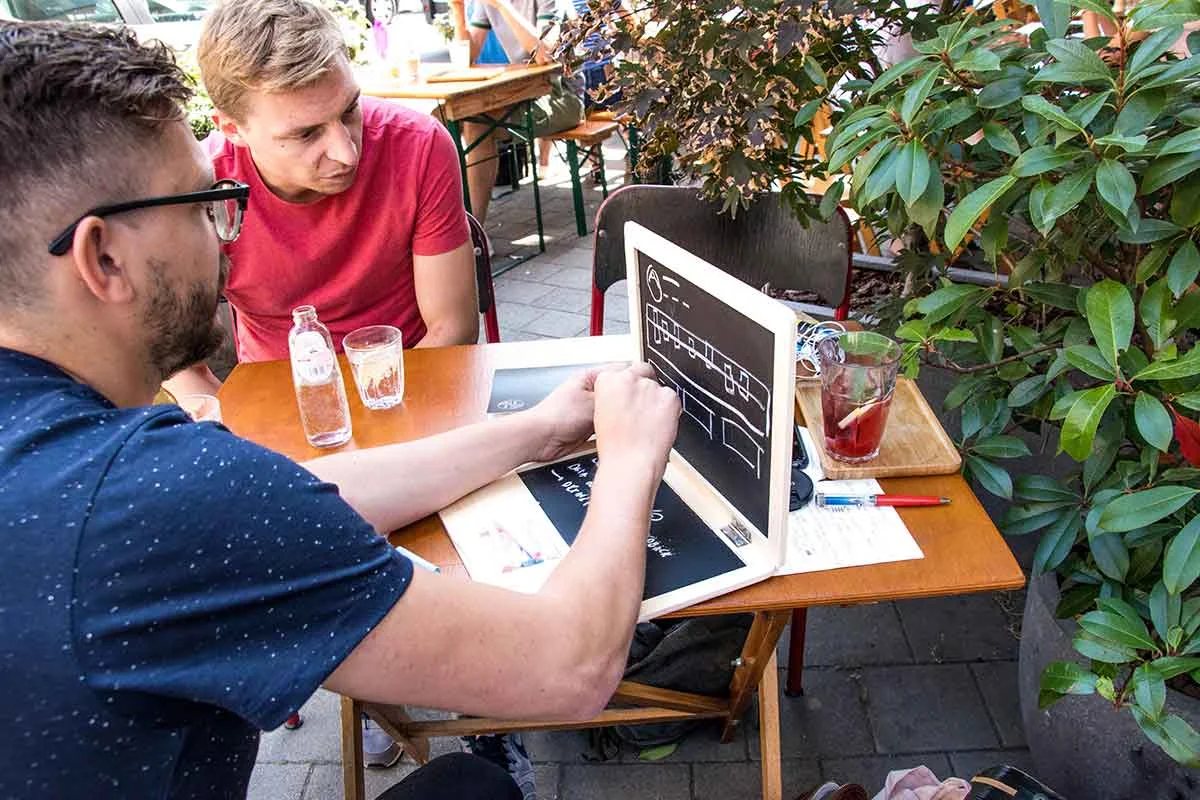
As soon as my ideas began to take more concrete forms, I once again reached out to the waiting professionals to validate my ideas. Sometimes with pen & paper, sometimes with a chalkboard laptop, but eventually with a digital prototype.
BUT IT'S NOT FINISHED YET
I tackled this challenge in just one week as just one-man-team, so there is still a lot left to explore. My proposal for FeatBACK is just the beginning. Currently I see six paths to set forth on this journey:
CONTINUE THE USER RESEARCH
Most of the wait staff I interviewed only worked in the hospitality industry as students or as a side job. So the product should be further evaluated by waiting professionals who see it as their main profession and future career.
User interviews and concept validation should also cover a wider age-spread, currently almost all interviewees were in their late twenties, early thirties.
Because of the small scope of this design challenge the the target audience was limited to Belgium and more specifically the province of Antwerp. In a continuation of this project, user testing should cover a more diverse set of stakeholders in order to validate the current execution of the concept. Giving feedback is highly dependent of one's culture.TECHNOLOGICAL FEASIBILITY
Willingness to adopt a mobile POS system such as Square should be researched. It might require a previsionary or simultaneous launch of a software integration into Bancontact systems (prevalent in the Benelux) in order to limit the barrier to entry to the feedback platform and facilitate a transition into a mobile POS system that would be more versatile.
Also, I am currently unsure about the feasibility of integrating Square's solution into other P.O.S. systems such as the (in Belgium) oft used Lightspeed.A VALIDATED BUSINESS CASE
More research should be done into which part of the platform could be monetized and what the willingness to pay is. The opportunity I would like to explore is a paid tier for venues to have access to the full profile of waiting staff if they do a custom search for a subscription fee.
Implementation of the system might also be charged (as an integration into their current P.O.S. solutions), but a case might be made that this might significantly negatively impact adoption.BEYOND THE FOOD SERVICE INDUSTRY
Currently, because of the short timeframe, I only looked at the food service industry, but this type of feedback platform can be extended to all customer facing roles both in retail and the hospitality industry.BUILDING A COMMUNITY
A 'hospitality industry community' can only work if there is virtually no barrier to entry for businesses to join. If its exclusive it won’t get enough traction from the general public, lose its value employees and thus won’t serve the purpose of connecting businesses and professionals. I focussed on the review flow in this design challenge, because you first need data before you can start using it in smart ways. But using this data is of course the end goal, so defining the community experience and the added value it brings to the food service professionals is paramount should this project continue further.THE SCIENCE BEHIND FEEDBACK
Giving feedback is a very sensitive and relevant topic. You don’t need to look to exaggerated futures as shown in Black Mirror to see that not only ratings, but also feedback is difficult to get right. This is something all organisations and companies struggle with (even Google wrote a blogpost about it). And it's made even trickier with the emotional disconnect of digital communication. So this should definitely be explored further. My decision to include negative feedback isn’t necessarily the right choice, so this should not only be validated by real-world use but also adjusted based on new scientific research insights.